
In the fall of 1918, the small hamlet of Oxford, Iowa numbered between 500-600 inhabitants. Typical Iowa fall activities were taking place: the school year resumed on September 3rd, Iowa Hawkeye football season had started September 28th, and crops were ready to harvest.
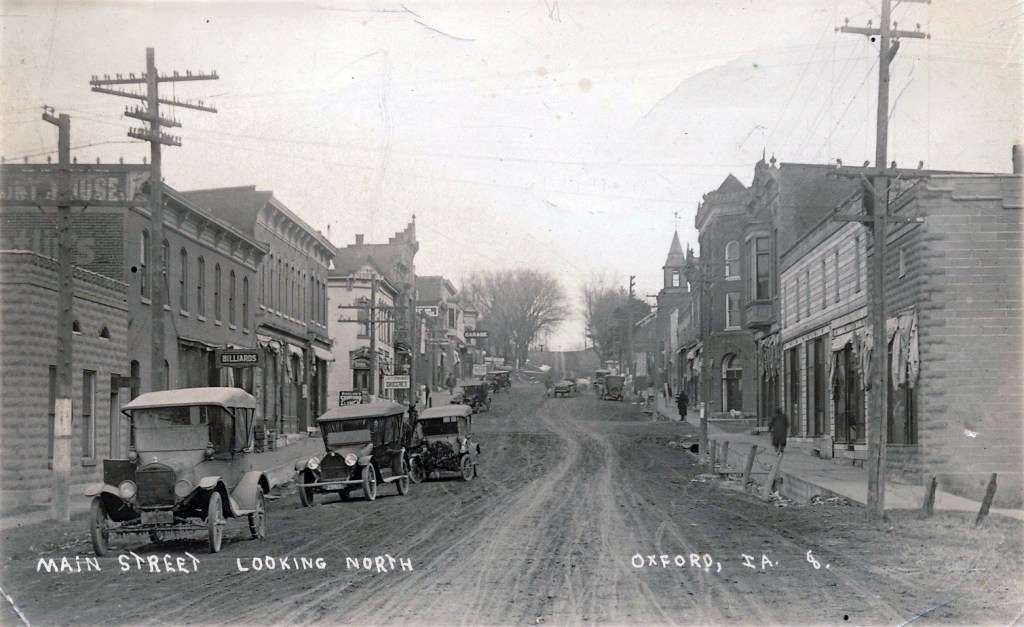
Having lived through the COVID lockdown in 2020, it almost feels like watching a horror movie when you can see the killer behind the main characters and you find yourself screaming at the screen, trying to warn them. You know that an outbreak is imminent.
October 3: the Oxford Leader reported on the new school year,
“Once more the teachers and pupils of the Oxford Public School have taken up their duties and are working heartily for and with one another. Every indication is toward a bigger, better school year than was the past school year. …”
“Back on the Job,” article, Oxford Leader (Oxford, Iowa), 3 Oct 1918, p. 1, col. 5; digital images, NewspaperArchive (https://access-newspaperarchive-com.proxy.stdl.org/us/iowa/oxford/oxford-leader/1918/10-03/ : accessed 22 July 2022).
One death reported: William E. Floerchinger
October 7: the school board closed school for “an indefinite length of time in order to prevent the spreading of influenza of which there are over fifty cases now in town.”
“Schools and churches, playhouses, moving picture shows, etc., were ordered closed Monday night by the board of health…as a medium of fighting the Spanish influenza. Other public places, public gatherings, lodge meetings, etc., were declared taboo for the time being, and the order becomes effective immediately.”
“Schools to Close,” article, Oxford Leader (Oxford, Iowa), 10 Oct 1918, p. 1, col. 3; digital images, NewspaperArchives (https://access-newspaperarchive-com.proxy.stdl.org/us/iowa/oxford/oxford-leader/1918/10-10/ : accessed 20 July 2022).
There were no tests to confirm and diagnose that someone was afflicted with “the Spanish influenza”. And there were no medications effective in treating it, nor machines to assist in breathing or intensive care units at hospitals.
The identified symptoms included:
- Sudden and high fever
- Dry cough
- Headache & body aches
- Sore throat
- Chills
- Runny nose
- Loss of appetite
- Fatigue
Often, patients developed pneumonia and other respiratory illnesses, which resulted in their deaths. Some even died the same day they became ill.
For communities that implemented prevention methods, there were no nationwide mandates. They closed public spaces like schools and churches, recommended wearing masks and washing hands.
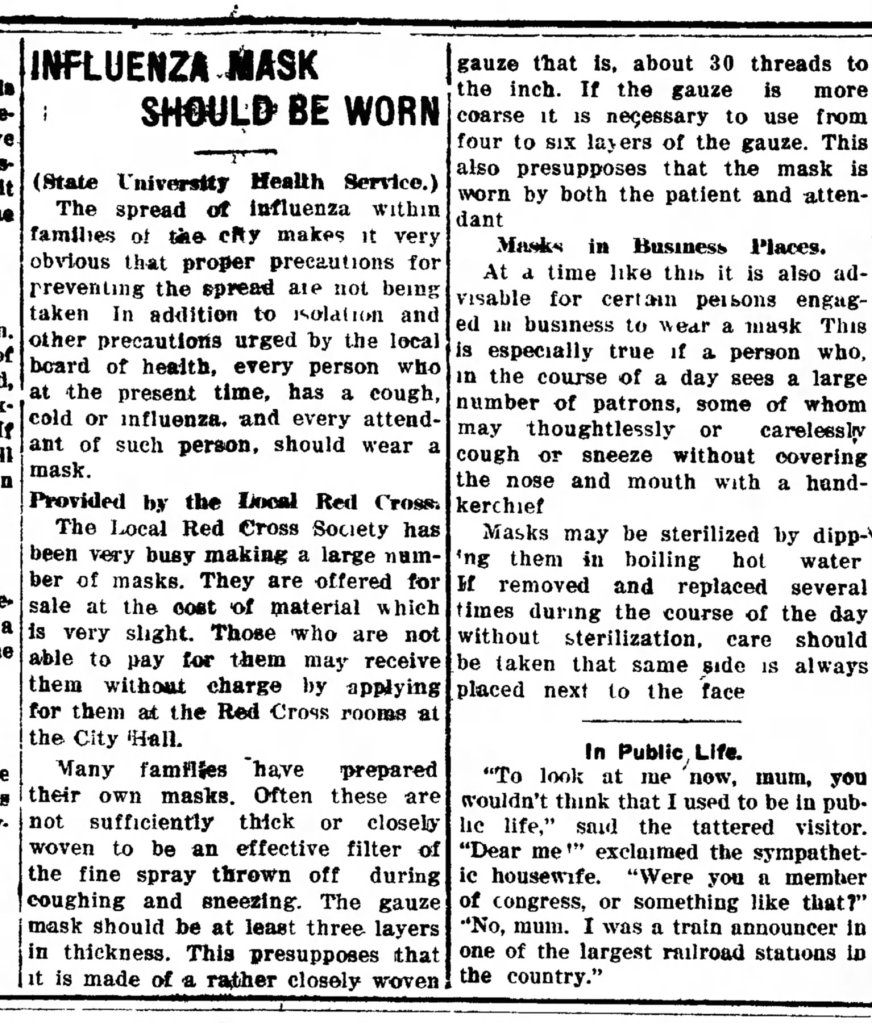
October 10: 50 cases and 1 death reported.
October 14: Cam DeLoss Hughes, local mercantile proprietor, died October 14, 1918 at his home at the age of 30 years old, and left a wife, Anna, and a 1 year old daughter, Patricia (“Death Toll Numbers Eight,” 1918).
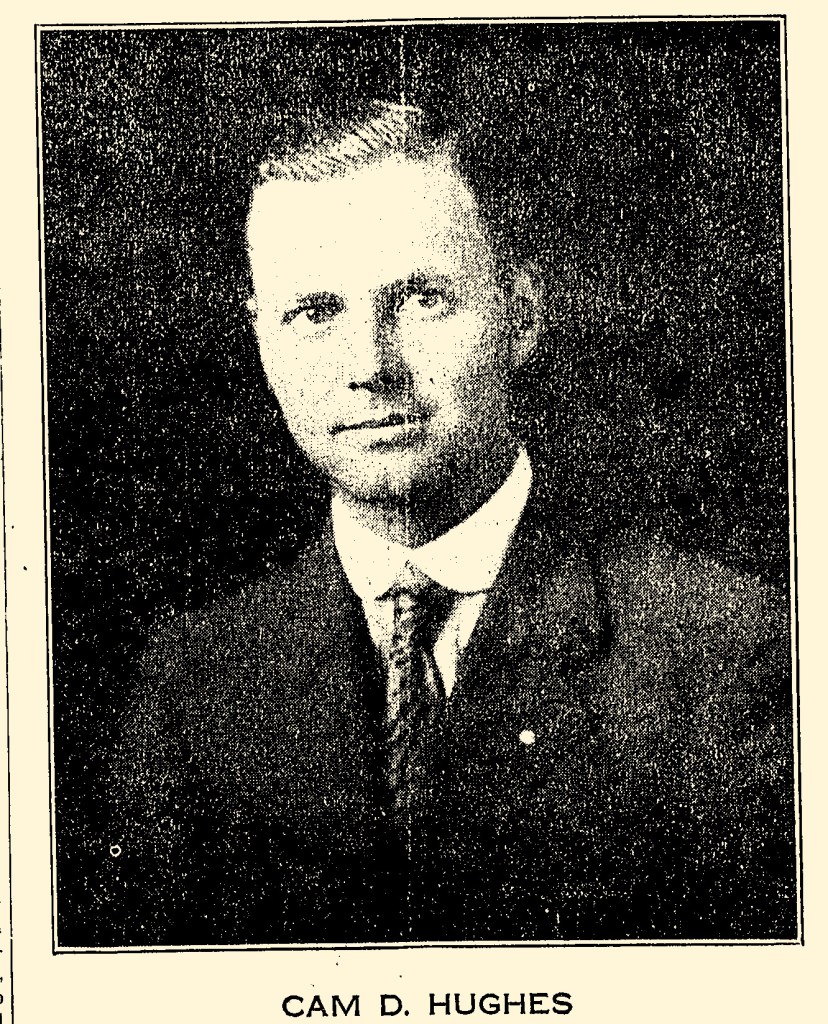
October 15: The day after Cam Hughes’ funeral, the mayor of Oxford
“reported 124 cases to the State Board of Health. These were all in the city limits, and, as he had no authority to report those just outside, the number in the vicinity of Oxford will be many more. …. The quarantine has not been raised here as yet and will not as long as new cases continue to develop. Nothing of a public nature is allowed, not even funerals.”
“The Influenza Does Its Work,” article, Oxford Leader (Oxford, Iowa), 17 Oct 1918, p. 1, col. 1; digital images, NewspaperArchive (https://access-newspaperarchive-com.proxy.stdl.org/us/iowa/oxford/oxford-leader/1918/10-17/ : accessed 20 July 2022).
At this same time, the Oxford school board decided to extend a “two week vacation in order to give the pupils the chance to help gather the large corn crop in this vicinity…..”
October 17: 124 new cases with 8 deaths reported.
October 23: The state draft board would issue a “[cancellation] of the draft order of Oct. 23, when 3900 Iowa boys were to go to Camp Greenleaf…..The movement of troops is suspended because of the influenza situation.”
October 24: Zero new cases and zero deaths reported in Oxford. 2,526 new cases and 27 deaths reported across the state of Iowa in the previous 24 hours.
October 26: The quarantine in Oxford was lifted. Schools and churches reopened, meetings and movie houses resumed normal services.
“The influenza has about subsided, at least in Oxford. There is not a single case inside the city limits and very few close around. There are a few with severe colds and other slight ailments, but the real “Flu’ is gone and we hope it will not return.”
“No More Influenza,” article, Oxford Leader (Oxford, Iowa), 31 Oct 1918, p. 1, col. 4; digital images, NewspaperArchive (https://access-newspaperarchive-com.proxy.stdl.org/us/iowa/oxford/oxford-leader/1918/10-31/ : accessed 20 July 2022).
Mention of the “Spanish Influenza” continue sporadically until February 1920 when the Oxford and Cosgrove schools closed due to “prevalence of Spanish Influenza in both communities.” But there does not appear to be the panic seen in previous reports.
“There seems to be an unusual amount of the disease in the vicinity, but as yet no cases have reached the critical stage.”
“Schools Closed Because of Flu,” article, Oxford Leader (Oxford, Iowa), 12 Feb 1920, p. 1, col. 2; digital images, NewspaperArchive (https://access-newspaperarchive-com.proxy.stdl.org/us/iowa/oxford/oxford-leader/1920/02-12/ : accessed 11 Sep 2022).
“Life in much of America came to a standstill in October 1918 as municipalities shuttered public gathering places such as schools, churches, theaters and saloons. With the Centers for Disease Control and Prevention still decades away from establishment, however, responses to the pandemic varied from city to city. “
Christopher Klein, “Why October 1918 Was America’s Deadliest Month Ever: It wasn’t because of World War I,” online article published 5 October 2018, History (https://www.history.com/news/spanish-flu-deaths-october-1918 : accessed 22 July 2022).
Almost 200K Americans died from the disease in October 1918 alone. And their loss was felt deeply in the Oxford community.
======
Sign up for my monthly newsletter here to keep informed of articles like this, book reviews, tips, freebies, and more!
======
Sources Used:
- “1918 Iowa Hawkeyes football team,” online article, Wikipedia (https://en.wikipedia.org/wiki/1918_Iowa_Hawkeyes_football_team : accessed 11 Sep 2022).
- “Back on the Job,” article, Oxford Leader (Oxford, Iowa), 3 Oct 1918, p. 1, col. 5; digital images, NewspaperArchive (https://access-newspaperarchive-com.proxy.stdl.org/us/iowa/oxford/oxford-leader/1918/10-03/ : accessed 22 July 2022).
- Christopher Klein, “Why October 1918 Was America’s Deadliest Month Ever: It wasn’t because of World War I,” online article published 5 October 2018, History (https://www.history.com/news/spanish-flu-deaths-october-1918 : accessed 22 July 2022).
- “Death Toll Numbers Eight,” article, Oxford Leader (Oxford, Iowa), 17 Oct 1918, p. 1, col. 3-6; digital images, NewspaperArchive (https://access-newspaperarchive-com.proxy.stdl.org/us/iowa/oxford/oxford-leader/1918/10-17/ : accessed 20 July 2022).
- “Draft Call is Postponed,” notice, Oxford Leader (Oxford, Iowa), 24 Oct 1918, p. 1, col. 2; digital images, NewspaperArchive (https://access-newspaperarchive-com.proxy.stdl.org/us/iowa/oxford/oxford-leader/1918/10-24/ : accessed 20 July 2022).
- “Main Street Looking North, Oxford, Ia,” digital photo posted 7 Sep 2018, Historical Oxford Iowa (https://www.facebook.com/historicaloxfordiowa/photos/325558521541994 :accessed 11 Sep 2022). Used with permission.
- “News of Oxford and Vicinity,” article, Iowa City Citizen (Iowa City, Iowa), 9 Oct 1918, p. 8, col. 4-5; digital images, Newspapers.com (https://www.newspapers.com/clip/105995565/iowa-city-press-citizen/ : accessed 20 Jul 2022).
- “No More Influenza,” article, Oxford Leader (Oxford, Iowa), 31 Oct 1918, p. 1, col. 4; digital images, NewspaperArchive (https://access-newspaperarchive-com.proxy.stdl.org/us/iowa/oxford/oxford-leader/1918/10-31/ : accessed 20 July 2022).
- “School Opened Last Tuesday,” article, Oxford Leader (Oxford, Iowa), 5 Sep 1918, p. 1, col. 1; digital images, NewspaperArchive (https://access-newspaperarchive-com.proxy.stdl.org/us/iowa/oxford/oxford-leader/1918/09-05/ : accessed 22 July 2022).
- “School Will Have Two Weeks Vacation,” notice, Oxford Leader (Oxford, Iowa), 17 Oct 1918, p. 1, col. 2; digital images, NewspaperArchive (https://access-newspaperarchive-com.proxy.stdl.org/us/iowa/oxford/oxford-leader/1918/10-17/ : accessed 20 July 2022).
- “Schools Closed Because of Flu,” article, Oxford Leader (Oxford, Iowa), 12 Feb 1920, p. 1, col. 2; digital images, NewspaperArchive (https://access-newspaperarchive-com.proxy.stdl.org/us/iowa/oxford/oxford-leader/1920/02-12/ : accessed 11 Sep 2022).
- “Schools to Close,” article, Oxford Leader (Oxford, Iowa), 10 Oct 1918, p. 1, col. 3; digital images, NewspaperArchives (https://access-newspaperarchive-com.proxy.stdl.org/us/iowa/oxford/oxford-leader/1918/10-10/ : accessed 20 July 2022).
- “Spanish Flu,” online article, Cleveland Clinic (https://my.clevelandclinic.org/health/diseases/21777-spanish-flu : accessed 22 Jul 2022).
- State University Health Service, “Influenza Mask Should Be Worn,” health notice, Iowa City Citizen (Iowa City, Iowa), 15 Oct 1918, p. 7, col. 4; digital images, Newspapers.com (https://www.newspapers.com/clip/17900588/oct-15-press-citizen/ : accessed 20 July 2022).
- “The Influenza Does Its Work,” article, Oxford Leader (Oxford, Iowa), 17 Oct 1918, p. 1, col. 1; digital images, NewspaperArchive (https://access-newspaperarchive-com.proxy.stdl.org/us/iowa/oxford/oxford-leader/1918/10-17/ : accessed 20 July 2022).
- “The Influenza is Much Better,” article, Oxford Leader (Oxford, Iowa), 24 Oct 1918, p. 1, col. 3; digital images, NewspaperArchive (https://access-newspaperarchive-com.proxy.stdl.org/us/iowa/oxford/oxford-leader/1918/10-24/ : accessed 20 July 2022).
Hey, just a heads up: My blog posts and email newsletters may contain affiliate links! If you buy something through one of these links, you won’t pay anything extra, but I’ll get a small commission, which helps me keep doing what I love. Thanks!
 Melissa Grandt Genealogy
Thank you for sharing, Melissa. A very well researched and presented article.
When I look at it, this is just one community out of what would have been thousands across America and up here in Canada.
What you have shared is so true. Back then there were no tests, no medications, no machines to help breathe, no intensive care units. It took an entire community to take it seriously. to help overcome the deadly virus. Only in a period of 23 days.
Your article brought to life what it would have been like.
LikeLike
Thank you for the comment! This is exactly what I was seeing. My 2x great-grandmother would die during October 1918. She lived about 10 miles from Oxford, the community in the post.
LikeLiked by 1 person