
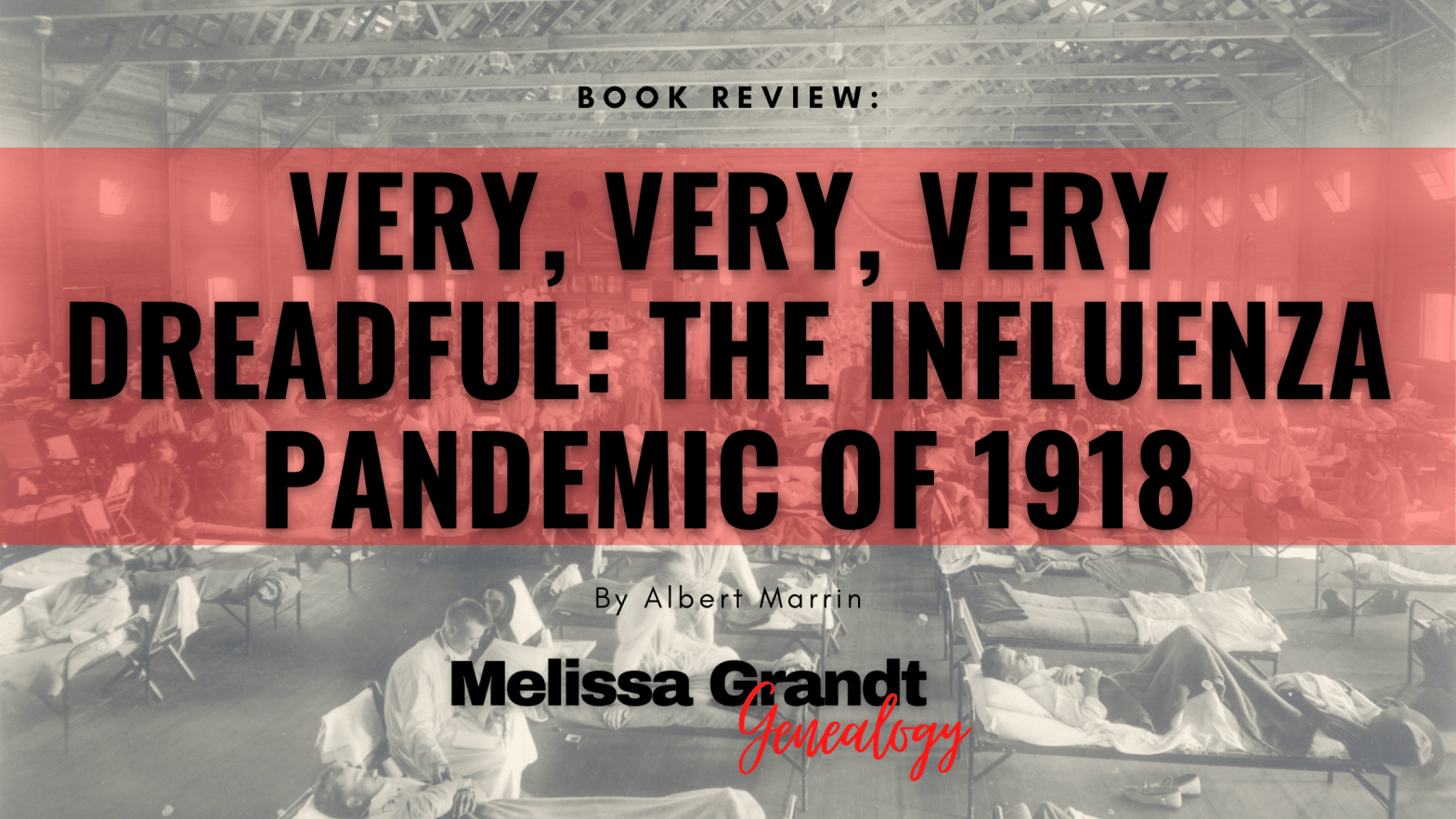
The book Very, Very, Very Dreadful: The Influenza Pandemic of 1918 by Albert Marrin reads like a middle school social studies textbook: simple, but informative. It is broken into five parts. The first two discuss the history of pandemics and how disease spreads during war. The next two talking about the pandemic start and its different waves. And finally, the science that has studied the disease since that time.
“By the end of October [1918], the hospital [at Camp Devens outside of Boston] counted 17,400 admissions for[influenza and pneumonia]. … ‘Every inch of available space was used…three miles of hospital corridors were lined on both sides with cots.” … Deaths skyrocketed, averaging 100 a day. [A private] remembered 374 patients dying in a single night.”
Marrin, Albert, Very, Very, Very Dreadful: The Influenza Pandemic of 1918 (Alfred A. Knopf, an imprint of Random House Children’s Books, a division of Penguin Random House LLC (New York) : 2018), p. 65; hardcover at Schaumburg Township District Library (130 South Roselle Road, Schaumburg, Illinois, Call Number: J 614.518 MARRIN, A); ISBN 9781101931462.
The book continues to discuss courses of treatment that rarely worked until the disease itself seemed to vanish in 1920. And while there were epidemics and pandemics after this one, they did not have the reach, nor were as lethal, as this strain in 1918.
“Americans today are well aware of the threat posed by pandemics. Novelists and filmmakers have created fictional accounts of viral catastrophes.”
Marrin, Albert, Very, Very, Very Dreadful: The Influenza Pandemic of 1918 (Alfred A. Knopf, an imprint of Random House Children’s Books, a division of Penguin Random House LLC (New York) : 2018), p. 156.
Interspersed with images and graphics from the time period, readers are brought to the present research involving the H1N1 virus.
Unknown to the author at the time of publication (2018), the COVID pandemic of 2020 would echo several of the points he makes in the final pages of his publication:
“The pandemic would have a cascading effect. Always eager for a sensational story, the media, particularly television, would spread panic. The labor force, because of sickness, fear, or having to tend to sick family members, would not report for work. Soon the economy would come to a standstill…Growing shortages of vital goods…would bring chaos. … Hospitals, mortuaries, and cemeteries would overflow as in 1918, only more so. “
Marrin, Albert, Very, Very, Very Dreadful: The Influenza Pandemic of 1918 (Alfred A. Knopf, an imprint of Random House Children’s Books, a division of Penguin Random House LLC (New York) : 2018), p. 157.
If you are looking for an overview of the Influenza Pandemic of 1918, or some background reading on the time period, this would be a good first stop in your research. But, it also leaves room for readers to dig further for more detailed information. Get your copy on Amazon here or through your local library.
Albert Marrin. Very, Very, Very Dreadful: The Influenza Pandemic of 1918. Alfred A. Knopf, an imprint of Random House Children’s Books, a division of Penguin Random House LLC (New York) : 2018; ISBN 9781101931462.
Similar books about the Influenza Pandemic or other pandemics that you may also enjoy:
- The Great Influenza: The Story of the Deadliest Pandemic in History
- America’s Forgotten Pandemic: The Influenza of 1918
- The Black Death: A History From Beginning to End (Pandemic History)
- Plague, Pestilence and Pandemic: Voices from History
- Hot Spot: A Doctor’s Diary From the Pandemic
- History Smashers: Plagues and Pandemics
- Epidemics and Society: From the Black Death to the Present
- HISTORY OF PANDEMICS: The definitive Guide to discover the worst and deadliest Epidemics and Pandemics that changed our World.
Hey, just a heads up: My blog posts and email newsletters may contain affiliate links! If you buy something through one of these links, you won’t pay anything extra, but I’ll get a small commission, which helps me keep doing what I love. Thanks!
 Melissa Grandt Genealogy